


Make No Small Plans. Then Get Them Done
Good planning creates a shared vision. Implementation turns that vision into stronger neighborhoods.
Introduction
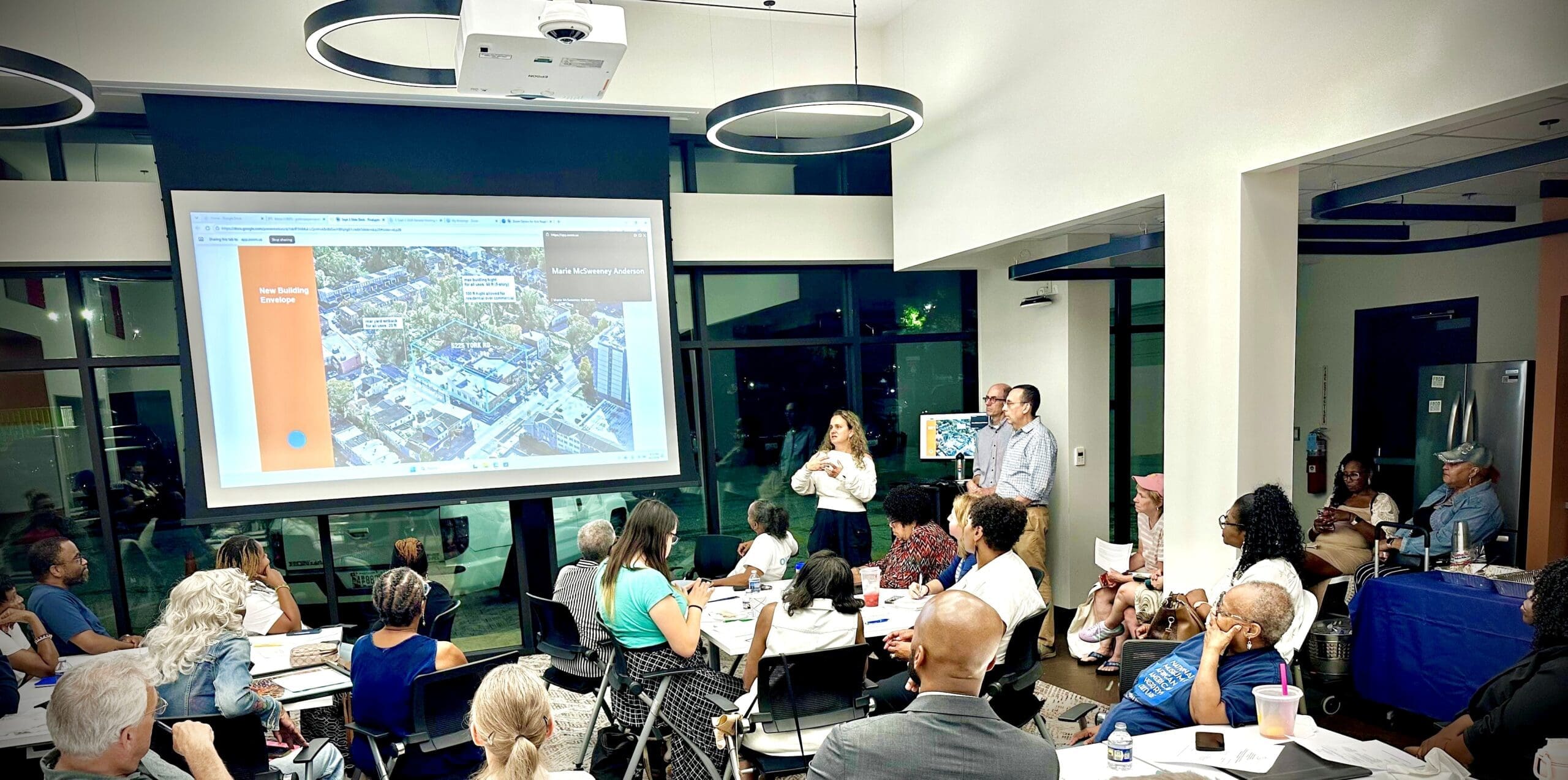
If you are sitting at a table with your neighbors, markers, and a flip pad, chances are you are at a community planning meeting.
Although I have a master’s degree in city and regional planning, I often describe myself as a recovering planner. No shade on planners. I believe deeply in planning and in the power of communities to imagine something better for themselves. But as the English mathematician and philosopher Alfred North Whitehead put it, “Ideas won’t keep. Something must be done about them.”
Baltimore has no shortage of plans. The Department of Planning’s website alone lists more than 75 neighborhood and area plans and studies – INSPIRE plans, Small Area Plans, neighborhood master plans, corridor plans, Strategic Neighborhood Action Plans and others.
That amount of planning is a strength. It is a gift to city decision-makers, representing hard-earned consensus around shared interests. Good planning gives residents a voice, establishes common priorities, and helps people who may disagree develop a shared vision. It also helps direct public, private, and philanthropic investment toward community priorities.
The Implementation Challenge
Plans need ownership and advocacy after adoption. Too often, responsibility for implementation becomes dispersed among agencies, funding sources, and competing priorities, with no one inside City government charged with carrying a plan from adoption to execution.
Consider an INSPIRE plan centered around a school. The Department of Transportation may own safe passage to school. Recreation and Parks may own the new playground. The Department of Housing and Community Development (DHCD) may have control over the vacant rowhomes next to the school, while Baltimore Development Corporation (BDC) may be responsible for acquiring a nearby liquor store. Each agency owns a piece. But who owns the plan? If everyone is responsible, no one is responsible.
That matters because plans raise expectations. Residents attend evening meetings, answer surveys, markup maps, debate priorities, and invest their time and faith in the process. They participate believing adoption will lead to action. When implementation is slow, fragmented, or unclear – when capital is not aligned, sites are not assembled, or regulatory barriers persist – frustration and cynicism can follow.
Implementation is not only about transformational ideas. Plans are filled with smaller recommendations – better crosswalks, pedestrian lighting, trees, traffic calming, community gardens, façade improvements, signage, public art, and improvements to existing parks. Collectively, these investments improve quality of life and quality of place.
Successful implementation can also help Baltimore achieve three broader goals – equitable redevelopment, population growth, and an expanded tax base. That builds wealth and creates additional resources to invest in neighborhoods and implement more of what communities have asked for. It can become a virtuous cycle: better neighborhoods attract people and investment, generating resources to make neighborhoods even better.
The York Road Corridor – A Case Study
Cap Ex Advisory Group is fortunate to be working with the Baltimore City Department of Planning, a stakeholder steering committee, and community groups to study the feasibility of redeveloping the city-owned Northern Community Action Center at 5225 York Road – a recommendation from the 2015 York Road Corridor Vision and Action Plan.
The plan was aptly named: it was meant to produce action, not sit on a shelf. Several recommendations have moved forward, including the creation of the York Corridor Business Improvement District (BID) and its regular cleaning and greening, corridor events and local merchant pop-ups, new murals and beautification, and gateway improvements at Govans Elementary School. More is underway, including improvements to community green spaces, gateway signage, and façade improvements at key commercial nodes.
Why has York Road made progress where some other communities with adopted plans have not?
One reason is ownership and implementers. Senator Mary Washington provided funding, Mayor Scott provided the mandate, and the Planning Department went outside its traditional role to encourage transformational real estate development. Strong community partners matter too. York Road has long benefited from organizations such as the York Road Partnership, GEDCO, and the new York Road Improvement District that advocate for their neighborhoods, attract resources, and sustain attention long after the planning meetings end. With partnership support from the Goldseker Foundation and the City, through Healthy Neighborhoods, Inc., the quarterback organizations were able to add staff capacity to support the organizing effort.
Building an Implementation Engine
Mayor Brandon Scott and the leadership teams at the Department of Housing and Community Development and the Department of Planning are considering a bold idea: merging the two departments. Done right, this could be much more than a government reorganization. Starting from the ground up creates an opportunity to make implementation a core mission for the new department.
A combined department could bring together planning with many of the tools needed to turn plans into projects: land-use authority, housing programs, development finance, site control, capital investment and redevelopment expertise. Just as important, it could create internal advocates for adopted plans – people responsible for competing for resources, coordinating agencies and moving priorities from recommendation to execution. This kind of implementation was once a hallmark of BDC. Under its new leadership, the quasi-public economic development agency is well positioned to reclaim that role.
The merger also creates an opportunity to put the “C” back in DHCD. Housing production is essential, but community development is broader in scope. Healthy neighborhoods also depend on commercial revitalization, placemaking, strategic land assembly, public spaces, infrastructure, neighborhood wealth-building, and long-term market stabilization.
If Planning and DHCD are merged, with BDC an active partner, the new department would have an opportunity to address this implementation gap directly. One approach would be to build a team of advocates and implementers into the new department, with singular responsibility for advancing a defined number of adopted neighborhood and corridor plans at any given time. Sort existing recommendations into four categories: completed, no longer appropriate, long-term investment, or achievable now. Then establish priorities, identify responsible agencies and funding sources, and start implementing them.
Communities have already done much of the hard work of defining what better should look like. The opportunity now is to build the capacity, ownership, and accountability to turn those plans into progress.
The team needs people who understand how projects actually happen – real estate, finance, land assembly, development underwriting, housing subsidy, regulatory approvals, capital budgeting, and project management. But technical expertise is not enough. Implementers need to be outcome-driven advocates. They need to make the case for their plans inside City government, compete for limited resources, persevere, coordinate agencies, remove obstacles, manage risk, and help government “get to yes.” Under new leadership, the Planning Commission has already begun to shift in this direction – revisiting adopted plans with a renewed focus on implementation and results.
They would not replace community organizations. Quite the opposite. They would give community advocates a counterpart within City government – someone who shares responsibility for advancing community priorities after the planning process ends. Not every community has organizations with the same capacity to be a full partner. The City could help build that capacity, creating strong community partners that can serve as force multipliers – advocating for priorities, attracting resources, and working alongside government to get things done.
Most of the existing plans on the Planning Department website are excellent, and nearly all include thoughtful implementation strategies. The West Baltimore MARC Station Master Plan, Historic Upton Neighborhood 2026 Master Plan, Jonestown Vision Plan, South Baltimore Gateway Master Plan, and Forest Park and Calvin Rodwell School INSPIRE Plan are just a few examples. These plans are assets; communities and planners have already done much of the hard work of defining what better should look like.
The powerful 2026 Historic Upton Neighborhood Master Plan illustrates both the opportunity and the challenge. Its implementation section contains roughly 68 recommendations and assigns “Lead Partner” roles to 12 City agencies, including CHAP, Planning, DGS, DPW, and Baltimore Main Streets. That breadth is necessary, but responsibility for individual recommendations is widely distributed, with no department responsible for the plan as a whole. Imagine one lead partner instead: a City implementation team, empowered by the Mayor, responsible for coordinating agencies, securing funding, removing obstacles, tracking progress, and ensuring the plan gets done.
Baltimore does not need to choose between planning and action. It needs to treat them as parts of the same responsibility. Communities have already spent years telling us what matters most. Mayor Scott’s proposed reorganization offers a rare opportunity to build on that work – creating a government better equipped to turn community priorities into projects, plans into progress, and vision into results.
Ready to take the next step? We’d love to chat with you!
